Resources:

Transcribed by me and free for you to use.
What do you think? Please leave a comment and let me know.
Resources:
Transcribed by me and free for you to use.
What do you think? Please leave a comment and let me know.
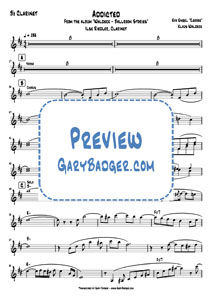
Our cover of the song “Addicted”. The original recording of this song features appears on the Waldeck album “Ballroom Stories”.
For this performance I transcribed the clarinet parts and played them on trumpet, making this my first clarinet transcription.
Credits:
Resources:
Transcribed by me and free for you to use.
What do you think? Please leave a comment and let me know.
Transcribed for trumpet, tenor sax, and trombone, for an upcoming gig.
Santana has performed many unique arrangements of this tune. This chart aligns to the recording “Live In Las Vegas 2015” where he added a two-piece horn section to his line-up.
Some related trivia from Wikipedia that I found interesting about this tune’s origins, composition, and meaning:
As Carlos Santana stated, “Neshabur is where the army of Toussaint Louverture – who was a black revolutionary – defeated Napoleon in Haiti. So that’s what it’s about. I think by writing songs like ‘Incident at Neshabur’ and ‘Toussaint L’Overture,’ we felt we were our own kind of revolutionary […] Alberto Gianquinto, our pianist on Abraxas, helped us a lot putting it together. The first part of the music is from Horace Silver’s ‘Señor Blues.’ The slow part is […] from Aretha Franklin’s ‘This Girl’s In Love With You.'”
There seems to be no place called Neshabur on Haiti or associated with the Haitian Revolution, nor has there been a single event in which the French army under Napoleon (who was never on Haiti) was defeated by the rebels under Toussaint (who had by then died in a prison cell in France). Possibly Santana confused the 1804 Haiti massacre, in which almost the entire white population of Haiti was killed, with the destruction and subsequent massacre of the entire population of Nishapur (also called Neshabur) in current day Iran by the Mongols in 1221.
Resources:

Transcribed by me and free for you to use.
What do you think? Please leave a comment and let me know.
I can’t count the number of times that I’ve heard guitartists and bass players bashing away at the main riff, through the walls at rehearsal studio complexes.
Now it’s our turn… Transcribed for a three-piece horn section to play at an upcoming gig.
Resources:

Transcribed by me and free for you to use.
What do you think? Please leave a comment and let me know.
Love this! Speaks for itself, really…
Resources:

Transcribed by me and free for you to use.
What do you think? Please leave a comment and let me know.

Having collaborated in over 400 online recording projects, there are a few lessons that I’ve learned for achieving the best results. I thought I’d pass on some of these on an ad-hoc basis. In this post, I’m sharing a few simple thoughts about how to play “tightly” together when you and your collaborators are not in the same room (or even in the same hemisphere).
When we play live, we know that a rock-solid connection is needed between the drummer and the bass player in order to sound tight and set a strong foundation for the other musicians. Without that, the band will sound loose and sloppy. These guys must work to lock things together and set the groove for everyone else to play in. We need to work hard when recording virtually, to ensure that we achieve the same standards of musicianship and performance discipline.
The order in which the tracks are recorded is key to achieving this.
Recording this way, from the ground up, we’re able to form and then build upon a strong, solid rhythmic and chordal foundation. And since backing tracks can often be tuned to something other than the A440 that our rhythm section will tune to, we avoid potential catastrophes by removing the backing track before vocals, horns, and strings can be deceived by it.
When I’m asked to collaborate on trumpet, I almost always wait until the rhythm section has completed its tracks before recording my own. This allows me to better play “in the pocket” rhythmically, while also avoiding the risk of accidentally tuning my ear and horn to a backing track that is not quite on A440.
Do you have any thoughts on this? Or better practices that you follow? If so, please share by adding a comment!
I was asked to play David Sanborn’s iconic alto sax parts for a recording of this David Bowie masterpiece. It’s a complex beast, but fortunately, I found the fine work of Scott Dart @SDartSax who had already transcribed it for alto sax. From there I transposed and played it.
Even for trumpet, I needed to belt out a High-E, which is a testament to Sanborn’s remarkable work to play a strong Double-B on alto. Bowie was very fortunate to have him in the studio!
The likelihood of anyone ever wanting to play this again on trumpet is probably zero. But maybe someone might want the transposition for soprano sax or clarinet one day, so here it is.
Thanks again to Scott Dart for his original transcription for alto sax. Be sure to check out his site!
Resources:

Transcribed by me and free for you to use.
What do you think? Please leave a comment and let me know.
Transcribed horn charts used for a one-off performance and virtual collaboration.
Resources:

Transcribed by me and free for you to use.
What do you think? Please leave a comment and let me know.
In memory of Bones Hillman.
Midnight Oil and its fans recently lost bass player and vocalist Bones Hillman. Bones sings the most beautiful backing vocals in this song and many others of the band’s. His passing is a terribly sad loss.
The “Powderworkers”, Midnight Oil’s global fan base, recorded a version of this song in tribute to Bones. I transcribed parts for flugelhorn, tenor sax, and trombone for our impromptu Powderworkers horn section. I based the parts on what I could hear from the DVD of the band’s 2009 Sound Relief performance and incorporated the French horn part as (faintly) heard on the original 1990 album recording. The horns play after the final chorus starts, after the 3:50 mark on this video.
As a long time fan of Midnight Oil, and having been to many, many live performances, it was an honor to transcribe and perform one of my favorite songs.
Rest In Peace, Bones.
Resources:

Transcribed by me and free for you to use.
What do you think? Please leave a comment and let me know.
Transcribed horn charts for an upcoming performance. Three-piece horn section, just as the Tedeschi Trucks Band uses: Trumpet, Tenor Sax, Trombone.
Resources:

Transcribed by me and free for you to use.
What do you think? Please leave a comment and let me know.
 Gary Badger's Trumpet Transcriptions