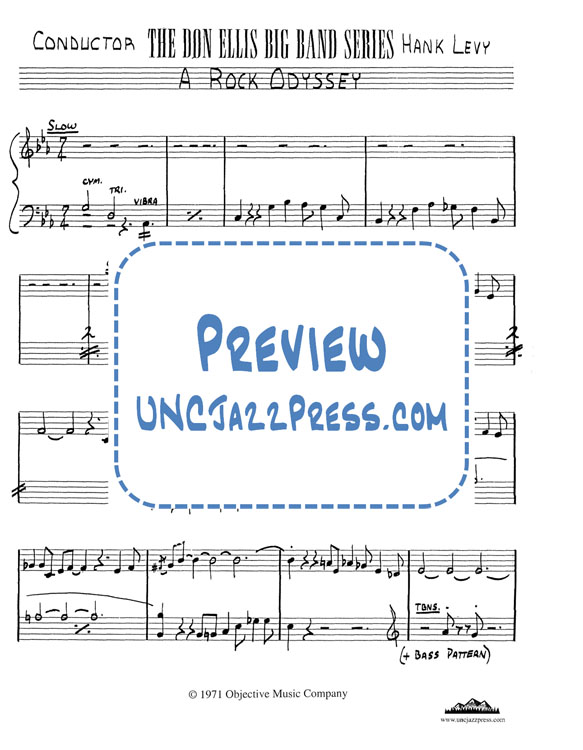
I recently recorded the introduction to one of my favorite Don Ellis Big Band tunes, A Rock Odyssey, composed by the brilliant Hank Levy. A masterpiece in 7/4 time!
While I played this snippet for YouTube as a ‘Short,’ I didn’t transcribe it so it’s not on offer here. But for those of you who want to dive into the full arrangement, you can grab the entire big band score and charts for just USD $40 from UNC Jazz Press!
PS: My video shows off the new range of Flugelhorn Mutes made in Australia by Tech Tone Mutes. No longer just for trumpets, cornets, and trombones. Check them out!
What if H.L.Clarke had been overly-influenced by J.S.Bach?
If it’s worth doing, it’s worth overdoing!
Clarke Study #2 is a staple for trumpet players, from students to professionals. But what if H.L. Clarke had been overly influenced by J.S. Bach? This trumpet exercise with a play-along video is my answer: an adaptation of the iconic theme from Bach’s Toccata and Fugue in D Minor—reimagined in the format of the Clarke study for B♭ trumpet. And instead of a boring metronome, we’re keeping things fresh with a funky backing track.
Looking to break free from your daily Clarke #2? Give this play-along a try for a little fun and variety. I made it to mix things up and give my neighbors a break from hearing the same old exercises—maybe you should too!
The written exercise is displayed on-screen as the video plays, while the PDF copy may be downloaded here.
This piece also doubles as an “Expanding Range” exercise, inspired by William Adam’s teaching approach. By starting in the middle register and gradually expanding up and down, you’ll be prepared for any range, high or low.
A quote from the book A Tribute to William Adam:
It may have been Mr. Adam who was the first to employ the concept of expanding exercises. Mr. Adam would start up in the middle register. Then we played the next exercise a ½ lower, then a ½ higher, and continue this pattern expanding outward. By doing this the player would not set themselves up for high or low register but instead be ready for either.
I recorded a brief demo to show Tech Tone trumpet cup mutes in action. These mutes play beautifully in tune and speak well. I think that they blend nicely when played in a section. Will let you decide for yourself after listening.
Australian-made Tech Tone Mutes are available in a range of colors and finishes at https://techtonemutes.com/
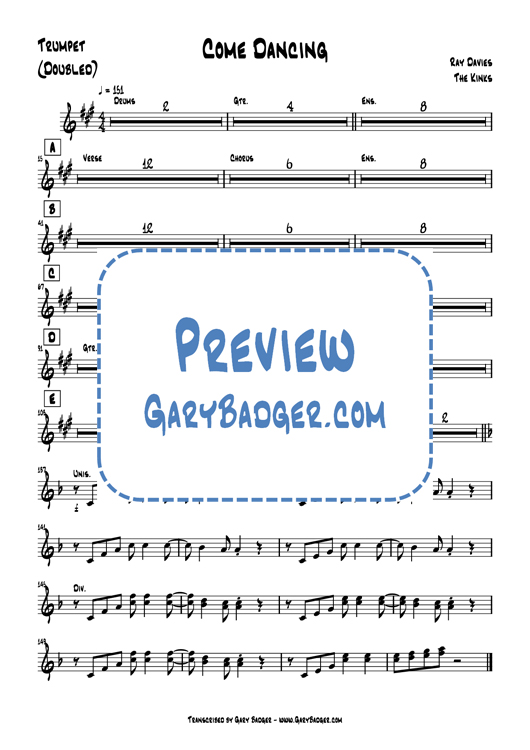
A full horn section features in the coda of Come Dancing – a song recorded by UK band The Kinks in 1982.
I’ve transcribed parts for trumpets, trombones, and saxes, mostly true to the original. For our recording, I was somehow able to get away with playing the trombone part on a combination of bass trumpet and slide trumpet (soprano trombone).
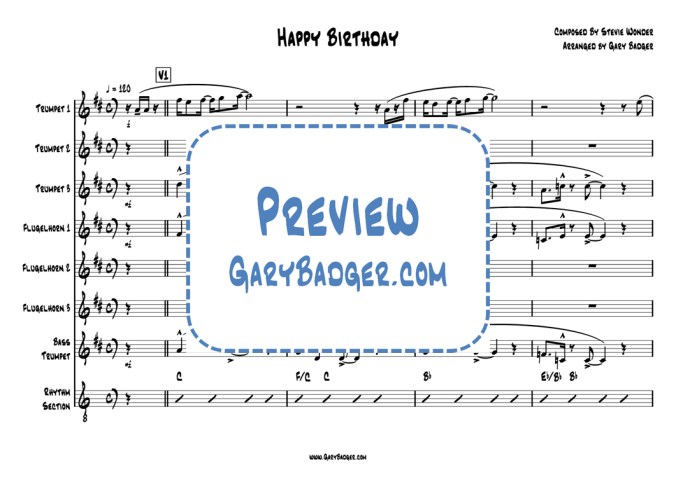
Each year my friends receive a special birthday greeting from me on Facebook, featuring one of my over-the-top renditions of Happy Birthday as seen in my Happy Birthday Trumpet Playlist.
This year I’ve created a new over-the-top version with which to honor my friends on their special day, arranging and recording a short version of Stevie Wonder’s Happy Birthday for 7 trumpets. And by 7 trumpets I really mean 3 trumpets, 3 flugelhorns, 1 bass trumpet, and a Band-in-a-Box rhythm section.
Any trumpet player caring to repeat this silliness for themselves is welcome to download and play my arrangement.
If you recall the original recording and cartoon video clip, you had an awesome childhood in the 1970s/1980s!
Love Is All from The Butterfly Ball and the Grasshopper’s Feast was a mid-70s hit in Europe. But its video, which features a guitar-playing frog, extended the song’s worldwide popularity and etched it into the minds of a generation. For years, ABC TV Australia used it as a filler before the nightly news, French TV played it nightly at station close, and children’s TV programs in the United States played it extensively.
We decided to have some fun with this too. I transcribed and recorded the horn sections parts for trumpet, flugelhorn, and trombone. And now you can play them too.
A big shout-out and congratulations to my friend Jean Michel aka “Mich Much” for leading this collaboration project for the 4 years that it took to come together, and his outstanding audio / video engineering.
As a B♭ trumpet player, I’m comfortable transposing at sight and playing parts for other instruments in different keys and clefs.
But working back the other way, quickly telling a student which notes they should be playing from trumpet to their instrument… well, that takes a little more mental processing time. And I might get it wrong! So I’ve adapted my Transposition Matrix to align with the instruments in my school music program.
This is not a theory lesson, but a brief video demonstration that aims to demystify the world of transposing instruments for you. All of the notes played sound identical, but are written differently depending on the instrument.
Find the note you want in the chromatic scale for your instrument, and see how that same note appears written for the other instruments.
If you think this tool might help your students or other tutors, please send them the link.
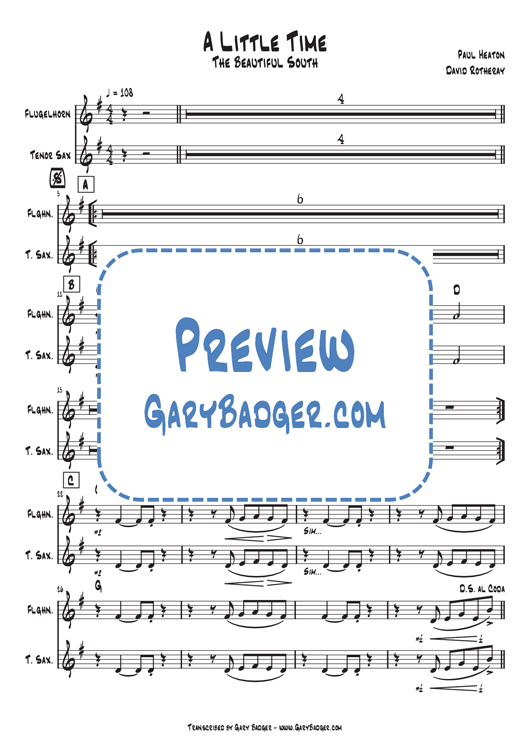
Some nice, understated backing lines for flugelhorn and tenor sax written for this song which peaked in the Top 20 in Europe, when released in 1990.
My transcription is true to the original recording. But I had a little time so I added some minor variations to it for our collab project, to give the horns a tiny bit more depth. This is where our recording differs a little from the original, and my transcription of it.




 Gary Badger's Trumpet Transcriptions